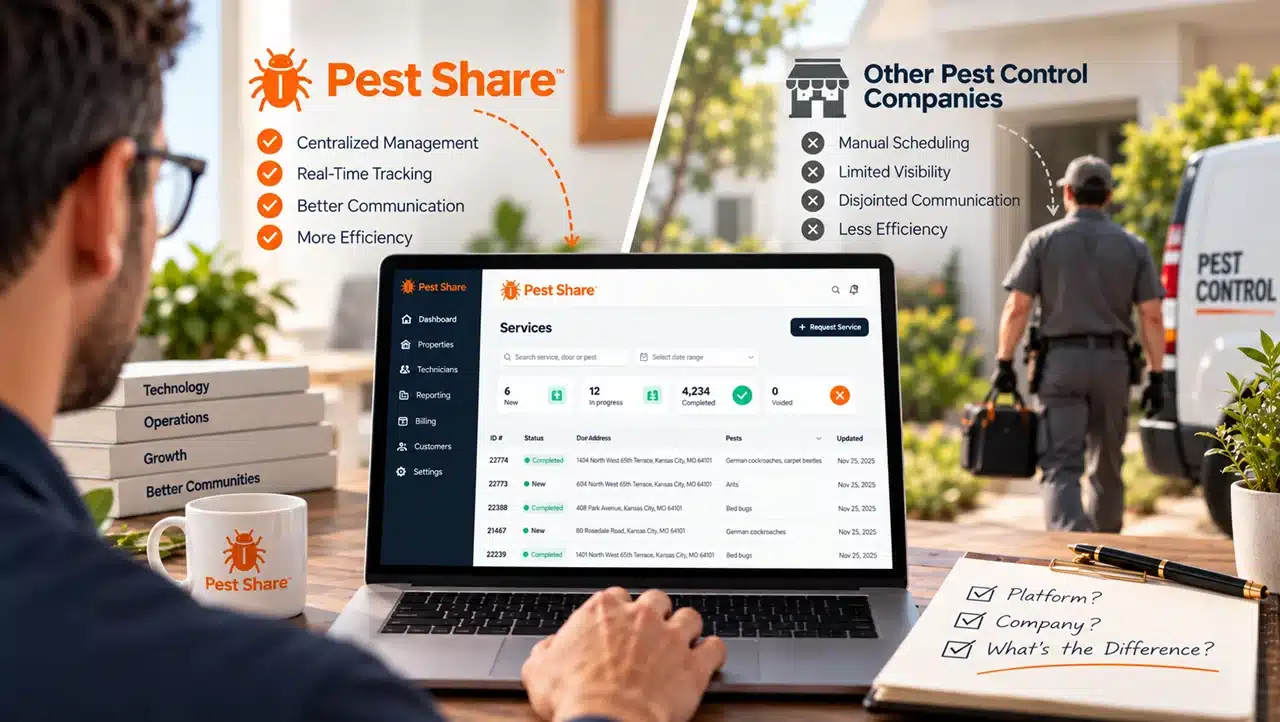
The main difference between a pest control platform and a traditional pest control company is what each one manages.
A traditional pest control company performs pest treatments. A pest control platform uses technology to manage the process around those treatments, from resident requests and service coordination to status tracking, documentation, and portfolio-wide visibility.
The pest control professional still performs the physical service. What changes is the infrastructure connecting residents, property teams, and providers.
For rental housing operators managing hundreds or thousands of units across multiple properties or markets, that distinction becomes increasingly important.
What is a traditional pest control company?
A traditional pest control company is a service provider that inspects properties, identifies pest issues, and performs physical pest treatments.
Typically, an owner or property team establishes a relationship with a local or regional pest control company. When service is needed, the property contacts the vendor, coordinates access or scheduling, and follows the job through completion.
For individual properties, that model can work well. The challenge appears when operators try to repeat the same process across a large portfolio. That can mean:
- Different pest control vendors across properties and markets
- Different pricing, service standards, and response times
- Requests arriving through phone calls, emails, work orders, or onsite teams
- Property staff coordinating appointments and following up with vendors
- Service records spread across vendor systems, inboxes, and property management systems
- Limited visibility into pest control activity across the portfolio
The problem isn’t necessarily the quality of the pest control provider. It’s that the operational process surrounding pest control is often decentralized.
What is a pest control platform?
An on-demand pest control platform is technology designed to manage pest control operations across multiple properties, providers, and markets through one standardized system.
Instead of requiring every property team to manage pest control independently, the platform creates a common workflow for requesting, coordinating, tracking, and reporting service. Depending on the platform, that can include:
- Digital pest control requests for residents
- Standardized request intake across properties
- Service coordination with qualified pest control professionals
- Centralized scheduling and status updates
- Service history and documentation
- Portfolio-wide visibility
- Performance and activity reporting
- Integrations with property management software
The physical pest treatment is still performed by a pest control professional. The technology platform manages what happens before, during, and after that service. For more details you can read our full article about what a pest control platform is and how it works.
Pest Control Platform vs Traditional Pest Control Company
| Comparison | Traditional Pest Control Company | Pest Control Platform |
|---|---|---|
| What it is | A pest control service provider | Technology for managing pest control operations |
| Primary role | Performs inspections and treatments | Manages the workflow surrounding pest control |
| Service delivery | Pest control technician | Pest control professional coordinated through the platform |
| Coverage | Typically defined by the provider’s service territory | Can support operations across multiple properties and markets |
| How requests begin | Phone call, email, work order, or property staff | Standardized digital request workflow |
| Coordination | Usually managed between the property and vendor | Centralized through the platform |
| Scheduling and updates | Often handled manually | Managed through a standardized system |
| Service history | May live across individual vendor or property systems | Centralized across the portfolio |
| Process consistency | Can vary by property, vendor, and market | Standardized across properties |
| Portfolio visibility | Limited | Centralized |
| Reporting | Usually vendor- or property-specific | Portfolio-wide |
| PMS integration | Varies by vendor | Can integrate with property management systems |
Does a pest control platform replace pest control companies?
No. A pest control platform does not eliminate the need for pest control professionals.
Someone still needs to inspect the property, identify the pest problem, and perform the treatment. The difference is that the operator no longer has to rely entirely on individual property teams to coordinate that process.
A platform becomes the operating layer between: Resident → Property operator → Pest control provider.
That allows the service itself to remain local while the process around it becomes centralized.
Why does this matter for rental housing operators?
Managing one pest control relationship is relatively straightforward. Managing pest control across hundreds of properties is a different operational problem.
As portfolios grow, operators may have dozens of vendor relationships, thousands of resident requests, multiple regional teams, different service agreements, and limited visibility into what is happening across the organization.
Without a standardized system, much of that coordination falls on property and maintenance teams. That creates operational work that has little to do with actually treating pests:
- Receiving resident complaints
- Identifying who should handle the request
- Finding the correct vendor
- Scheduling service
- Following up when residents or providers don’t respond
- Tracking whether the work was completed
- Resolving missed appointments
- Finding historical service information
- Comparing activity across properties
A pest control platform standardizes those workflows so pest control can operate as one portfolio-wide process rather than hundreds of individual property-level processes.
What does the difference look like in practice?
Imagine a resident reports a cockroach problem.
With a traditional vendor model
The resident may contact the property team. Someone at the property determines which pest control company services the building, contacts the vendor, provides the resident or unit information, coordinates scheduling, and follows up if anything changes.
The details of that interaction may live in emails, work orders, vendor portals, or individual team members’ notes.
With a pest control platform
The resident submits the request through a standardized digital workflow. The request enters the same operating system used across the portfolio. Service can then be coordinated with a qualified pest control professional, while status, communication, and service information remain connected to the request.
Property teams can see what happened without rebuilding the history from emails or phone calls.
Multiply that difference across thousands of requests, and the value of standardization becomes much more significant.
What happens when something goes wrong?
The operational difference is often easiest to see when a service request doesn’t go exactly as planned. For example:
- A provider misses an appointment
- A resident doesn’t respond
- The pest issue requires additional information
- A service request needs follow-up
- A property team member changes roles or leaves the organization
In a decentralized model, resolving the issue can depend heavily on whoever originally coordinated the request.
In a centralized platform, the request history, service status, communication, and outcome remain connected in one system. That makes the process less dependent on individual institutional knowledge and gives operators better visibility into recurring patterns across properties and markets.
Can operators keep their existing pest control vendors?
Yes. Using a pest control platform does not necessarily mean replacing every existing pest control relationship.
A platform can help standardize the operating process while allowing operators to maintain provider relationships that are already working well. It can also extend coverage into markets where an operator does not already have a preferred provider.
The fundamental shift is not necessarily who performs pest control. It is how pest control is operated across the portfolio.
When does a pest control platform make sense?
A traditional direct-to-vendor model may be sufficient when an organization has a small number of properties concentrated in one market.
A platform becomes more valuable as operational complexity increases. That can include operators with:
- Hundreds or thousands of rental units
- Properties across multiple markets or states
- Multiple pest control vendors
- Centralized operations teams
- Large onsite or maintenance organizations
- A need for consistent resident processes
- Limited portfolio-wide reporting
- Plans to continue acquiring or expanding properties
The more locations, vendors, residents, and service requests an organization manages, the more valuable a standardized operating layer becomes.
Is pest control software the same as a pest control platform?
Not necessarily. Many pest control software products are built for pest control companies. They help service businesses manage technicians, routes, invoicing, customers, or field operations.
A pest control platform for rental housing serves a different user. It is built for property operators managing pest control across a portfolio, connecting the resident request, property team, service workflow, and pest control provider through one system.
That distinction is important when evaluating technology. The question is not simply “Is this pest control software?” It is “Who was this software built to help operate pest control?”
An example of a pest control platform
Pest Share is an on-demand pest control platform built for rental housing.
It gives multifamily and single-family rental operators one technology system for running pest control across properties and markets.
Rather than operating like a traditional local pest control company, Pest Share connects residents, property teams, and qualified pest control professionals through a standardized workflow.
Residents can submit pest control requests digitally. Pest Share coordinates service and keeps the workflow connected from request through resolution. Property teams can see pest control activity across their portfolio instead of managing each request independently.
Pest Share also integrates directly with the property management systems rental housing operators already use, including Yardi, Rent Manager, Buildium, and RentVine, helping pest control fit into the systems and workflows their teams use every day.
The goal is not to replace the pest control professional. It is to replace the fragmented process operators traditionally have to build around them.
Validated impact
Operators using Pest Share have seen up to $102K in annual revenue impact per 1,000 units.
90% less time spent on vendor management.
Resident satisfaction scores moving from 29 to 88.
What should operators look for in a pest control platform?
When comparing pest control platforms, operators should evaluate more than provider coverage and cost. Important questions include:
- Can residents submit requests directly?
- Is the request process standardized across every property?
- How is service coordinated?
- Can the platform operate across multiple markets?
- What visibility does the corporate team have?
- Can teams see historical pest control activity?
- How are exceptions and follow-ups handled?
- Does the platform integrate with existing property management technology?
- Can the operator maintain existing provider relationships where appropriate?
- What reporting is available across the portfolio?
- How does the system handle growth into new properties or markets?
The strongest platform should make pest control easier to operate as the portfolio gets larger, not create another system that property teams have to manage.
The bottom line
A pest control company performs pest control. A pest control platform provides the technology and operating infrastructure for managing pest control across a rental housing portfolio.
Both are part of delivering pest control services. They simply solve different problems.
For a small number of properties, managing vendor relationships individually may be perfectly reasonable. For multifamily and single-family rental operators managing hundreds or thousands of units across properties and markets, centralizing the process can create a more consistent and scalable way to run pest control.
Pest Share brings residents, property teams, and pest control providers together through one technology platform, giving rental housing operators one system for running pest control across every property and every market.