A pest control platform is technology that gives property managers and operators one system to manage pest control across residents, properties, service providers, and markets. Instead of relying on property teams to coordinate residents, vendors, scheduling, service updates, and records manually, an on-demand pest control platform connects those steps into one workflow from resident request through resolution and portfolio-wide visibility.
For rental housing operators, that means pest control can function more like modern property technology: centralized, trackable, standardized, and able to scale across properties and markets.
What does a pest control platform actually do?
A pest control platform acts as the technology layer between residents, property management teams, and pest control service providers. The exact capabilities vary by platform, but the purpose is the same: turn a traditionally fragmented operational process into a connected system.
For a rental housing operator, that can include:
- Giving residents a digital way to submit pest issues
- Capturing the information needed to determine the appropriate next step
- Coordinating service with qualified pest control providers
- Managing scheduling and resident communication
- Tracking requests from submission through completion
- Centralizing service history and status information
- Giving property teams visibility across properties and markets
- Connecting pest control workflows with existing property management technology
How is a pest control platform different from a pest control company?
A traditional pest control company or exterminator provides pest control service. A pest control platform provides the technology and infrastructure used to manage pest control across a portfolio. That distinction becomes increasingly important as a rental housing portfolio grows.
| Traditional Pest Control Company | Pest Control Platform |
|---|---|
| Performs pest treatments | Manages the workflow around pest control |
| Typically operates within defined service territories | Can coordinate service across multiple markets |
| Individual vendor relationship | Centralized operating system |
| Requests often begin by phone, email, or work order | Digital request workflow |
| Scheduling coordinated manually | Scheduling can be automated or centralized |
| Information often lives with individual properties or vendors | Portfolio-wide visibility |
| Different processes by vendor or market | Consistent process across the portfolio |
| Primarily a service provider | Technology platform connecting operators, residents, and providers |
Pest control professionals still perform the physical service. The difference is what happens around that service. A platform provides the infrastructure that connects the process. For a full side-by-side breakdown, see our comparison of pest control platforms vs. pest control companies.
Why does rental housing need a pest control platform?
Pest control becomes an operational problem when it has to be managed repeatedly across hundreds or thousands of homes.
Consider what happens when a resident reports a pest issue through a traditional process. Someone needs to receive the complaint. Determine what happened. Decide who is responsible. Find the correct vendor. Contact the vendor. Coordinate access with the resident. Schedule the service. Follow up. Confirm completion. Record what happened.
Multiply that process across different communities, regional teams, vendors, and markets, and pest control becomes much more than the treatment itself. The challenge is orchestration — and a pest control platform is designed to remove that fragmentation by creating one operating model across the portfolio.
How does a pest control platform work?
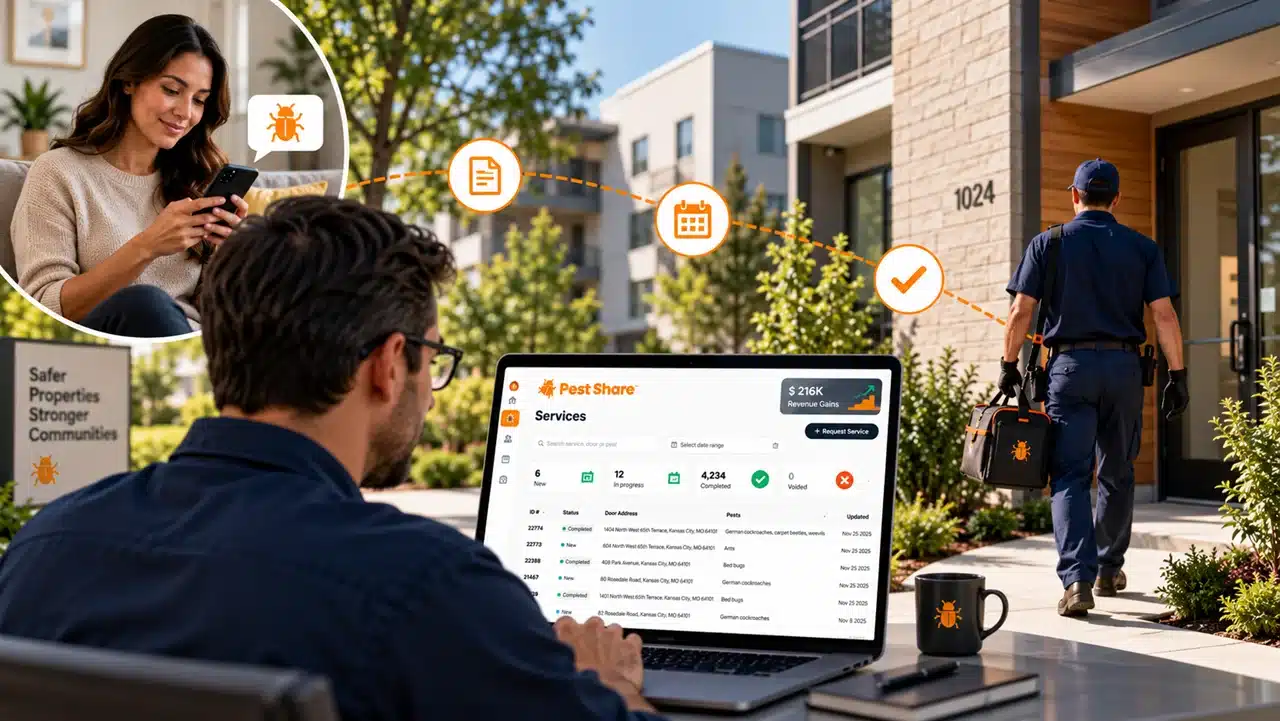
A modern pest control platform typically connects three groups: the resident who needs service, the property operator responsible for the home, and the pest control professional who performs the treatment.
- A resident reports the pest issue. The request is submitted digitally rather than requiring the resident to begin with the leasing office, maintenance team, or a local vendor.
- The platform processes the request. Information about the issue is captured, organized, and routed through a standardized workflow.
- Service is coordinated. A qualified pest control provider is connected to the request and service is scheduled.
- Residents receive updates. Communication happens directly through the process instead of depending on onsite teams to relay every update.
- Property teams maintain visibility. Operators can see requests, service status, history, and other information without manually coordinating each job.
- The physical treatment still happens in the home. What changes is everything required to get from “I have a pest problem” to “the problem has been serviced.”
Is a pest control platform the same as pest control software?
Sometimes. Pest control software often refers to tools built for pest control companies themselves, helping technicians manage routes, scheduling, billing, or field service operations.
A pest control platform for property management is built around the operator and resident experience instead. Its job isn’t to help a pest control company run its business. It’s to help a rental housing operator run pest control across its portfolio. That difference in end user changes the product considerably.
Is a pest control platform just vendor management software?
No, and this is where platforms and providers can work together rather than compete. Vendor management may be one component of the system, but a platform goes beyond maintaining a list of vendors or assigning work. It connects the full pest control journey: request intake, resident communication, service coordination, provider dispatch, status tracking, service history, and portfolio reporting.
That also means using a platform doesn’t require an operator’s existing pest control relationships to disappear. Technology can sit alongside those relationships, supplementing coverage where needed or providing infrastructure in markets where an operator doesn’t already have the right vendor in place. The bigger shift isn’t which technician performs the treatment — it’s how the entire process is managed.
Why does this matter for multifamily operators?
For multifamily operators, pest control can involve thousands of individual resident experiences spread across communities, onsite teams, regional leadership, and service providers.
A platform creates a common system across those groups. Instead of each community establishing its own process, operators can standardize how pest issues are submitted, routed, serviced, and tracked giving enterprise teams greater visibility without requiring onsite teams to become pest control coordinators. The result is a model designed to scale across communities rather than being rebuilt property by property.
Why does this matter for single-family rental operators?
Large single-family rental portfolios face a different version of the same challenge. Homes may be distributed across dozens of cities or states, making local vendor management particularly difficult. A process that works when an operator manages homes in one market can become complicated quickly as the portfolio expands.
A pest control platform allows an SFR operator to establish one pest control workflow across geographically dispersed homes. The operator gets consistency, residents get a consistent way to request service, and local pest control professionals still perform the physical treatment — without the portfolio needing a different operational process every time it enters a new market.
What should property managers look for in a pest control platform?
The most important question isn’t whether a company offers an online dashboard. It’s whether the platform actually changes how pest control operates.
Rental housing operators should evaluate factors like resident request experience, workflow automation, provider coverage, service coordination, portfolio-wide reporting, PMS integrations, resident communication, implementation, and the platform’s ability to support the size and geographic complexity of the portfolio.
For enterprise operators, the test is straightforward: can this system become one scalable pest control workflow across the portfolio, or will our teams still need to manage the process market by market?
What are the benefits of using a pest control platform?
For rental housing operators, the value is primarily operational. A platform can reduce the manual steps required to coordinate service, create a consistent resident experience, centralize information, make service activity visible across the portfolio, reduce dependence on market-by-market processes, and make it easier to scale pest control as the portfolio grows.
Technology turns pest control from a collection of individual transactions into a system.
What is an example of a pest control platform?
Pest Share is an on-demand pest control platform built specifically for residential property management. Rather than operating as a traditional pest control company, Pest Share uses technology to connect rental housing operators, residents, and a nationwide network of vetted pest control professionals. That network today spans 48 states, 400,000+ doors, and 1,000+ clients.
Residents submit pest issues digitally. Pest Share coordinates the workflow and service on demand — matching each request with a vetted local provider without manual coordination from onsite teams. Property management teams maintain visibility into what’s happening across their portfolio through one dashboard, integrated directly with the PMS tools they already use — including Yardi, Rent Manager, Buildium, and RentVine.
For multifamily and single-family rental operators managing pest control this way, the operational impact shows up in the numbers: operators have seen up to $102K in annual revenue impact per 1,000 units and 90% less time spent on vendor management, with resident satisfaction scores moving from 29 to 88.
The future of pest control is a platform, not another manual process
Property management has spent years moving critical operations into connected technology. Leasing has platforms. Payments have platforms. Maintenance has platforms. Resident communication has platforms.
Pest control has largely remained a collection of emails, phone calls, work orders, local contracts, and vendor relationships.
A pest control platform changes that. It doesn’t replace the pest control professional who solves the problem inside the home — it replaces the fragmented infrastructure surrounding that service with a connected system. For rental housing operators managing increasingly large and geographically complex portfolios, that distinction matters.
Pest Share brings residents, property teams, and pest control providers together through one technology platform — so operators can run pest control consistently across every property and every market.